
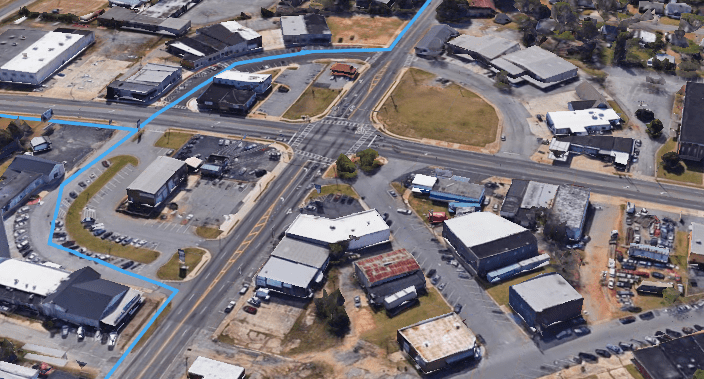
Warner Robins is a product of what Strong Towns would call the suburban experiment. Georgia’s largest industrial complex broke ground in 1942, and what we now call Warner Robins developed entirely during the post WWII period. While some cities were demolished to make way for cars, in Warner Robins there was never a city to demolish. The promise of “modern” roads, spacious yards, and abundant parking meant Warner Robins was never really urban. A product of its time, Warner Robins has always been a suburb – a suburb without a city…
And because of that, we drive — a lot. That’s not going to change. Outside a calamity, driving will be a big part of our lives in the Robins Region for the foreseeable future. Most of us like it that way, and many of us have never known anything different. I’ve driven about 25,000 miles per year for many years, most of it in Houston County. While we might gripe, our traffic is easy, our roads are efficient (as long as you don’t get killed or maimed), and parking is a breeze. So why would Warner Robins want a “downtown”? What’s the point?
Downtowns are efficient. On a per acre basis, done right, a mixed use downtown will be the most productive land in the city. With empty lots and abundant space, we have plenty of room to thicken. Land with supporting infrastructure not used, while we spend millions to expand roadways and add utility infrastructure to empty fields, enables us to move further and further away from our historic core. Yet, as Strong Towns would explain, without this continued expansion, our finances are stressed. While it might not show in the books, it shows as once prominent areas change.
Today, our first and second generation neighborhoods show signs of decline. Our outward expansion provides the illusion of wealth and growth, while in reality we struggle to maintain the things already built. A successful downtown, while not a panacea, will counterweight this trend. Within three miles of Commercial Circle there are greater than 47,000 residents. Despite that, many areas within this most dense area of Warner Robins are sparse. This is understandable. What is the advantage to in town living?
Currently, not enough. While we want to avoid arguing for gentrification, the immediate area of downtown development does not currently house many people, but those neighborhoods immediately surrounding downtown could show improved value. That would be a sign of success. A renaissance within this traditional core will add value for local citizens, and a well-conceived downtown will provide fertile ground for local entrepreneurship.
What is the character of a well-conceived downtown? What would its competitive advantage look like? How would it compete with existing strip malls and their inherent convenience?
For starters (insert “live, work, play” cliche here) downtown must be a place where people live. Done right, downtown will appeal to the kind of educated young workers the base and businesses desire. Likewise, older residents who may want to downsize will have a lifestyle option that Warner Robins does not currently offer. As our city competes with many other communities to draw residents, an absence of this kind of lifestyle leaves a big gap in our desirability.
A pedestrian and bicycle-friendly downtown will enhance the overall quality of life for residents. Access to amenities, green spaces, and cultural attractions within walking or biking distance can lead to healthier, more vibrant communities. A well-designed downtown can attract tourists, encourage local spending, and stimulate small business growth. Encouraging alternative modes of transportation like walking and biking can help reduce air pollution, alleviate traffic congestion, and decrease carbon emissions, contributing to a more sustainable future for Warner Robins. A pedestrian-friendly downtown can serve as a gathering place for residents of all ages, fostering social interactions and community cohesion. Investing in a downtown area that prioritizes pedestrians and cyclists can future proof Warner Robins against potential challenges and ensure its long-term viability as a thriving community.
A place where residents can walk or bike to restaurants, shopping, work, recreation, or just enjoy community, does not exist in Warner Robins. Building a place scaled to people and not machines will bring lifestyle choices that people of the 21st century want. Evolving from a 20th century model of development to a 21st century model will also help ensure Robins Air Force Base is a part of this community for generations to come, and that will secure a future for us all!
 Ride Robins
Leave a comment