

The Houston County Joint Comprehensive Plan identifies two ideas to integrate development with neighborhoods. The first, under the subheading “Industrial Areas”, describes “nodes along major corridors”.

What nodes, and where? That’s not defined, but the implication is commercial and residential development concentrated around “industrial parks”.
That our large work centers should be well-connected to nearby neighborhoods with safe for all ages and abilities micromobilty infrastructure is not the same question as anchoring a zone (or community) to a center. What a center needs is retail and restaurants. And while “industrial parks” do employ people, sometimes lots of people, if you don’t work there there’s no reason to go there. A better node would look more like an urban village, and wikipedia’s definition nicely aligns with the suggested development patterns of the Houston County Joint Comprehensive Plan :

The question becomes, “Where do you anchor your urban villages?”. But before that’s answered, let’s explore the comprehensive plan’s other idea for integrating development with neighborhoods. No surprise, this one is called the “Rural Village”. What is a “Rural Village”?
And how might these villages be anchored?

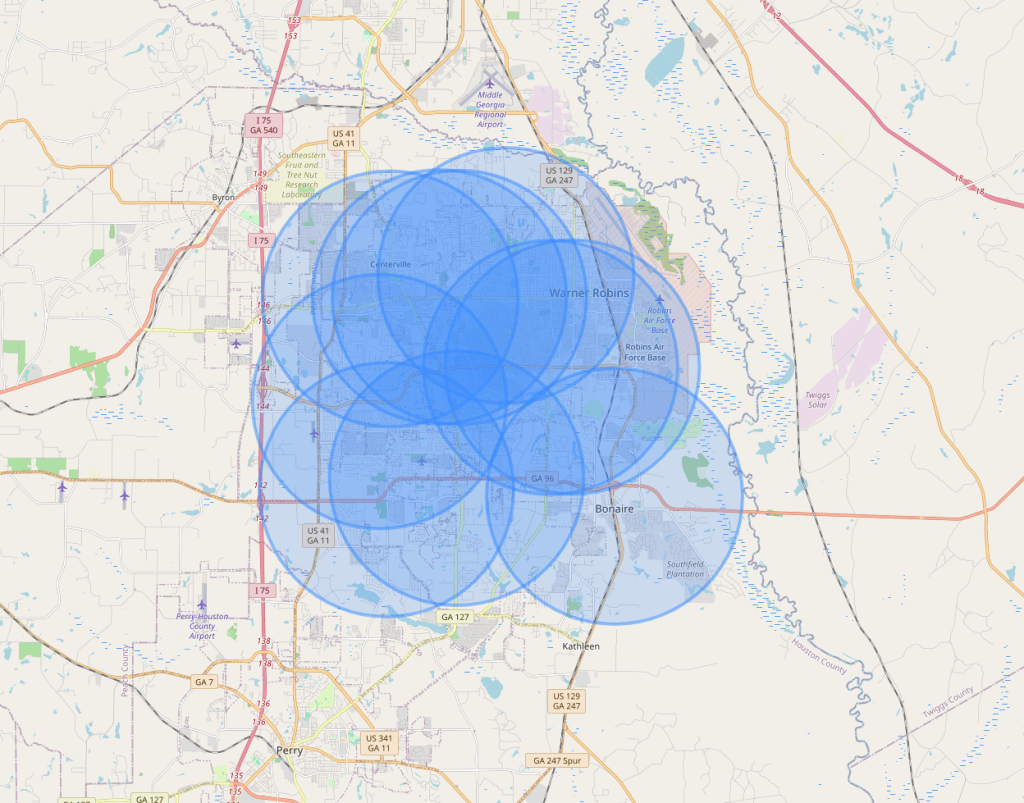
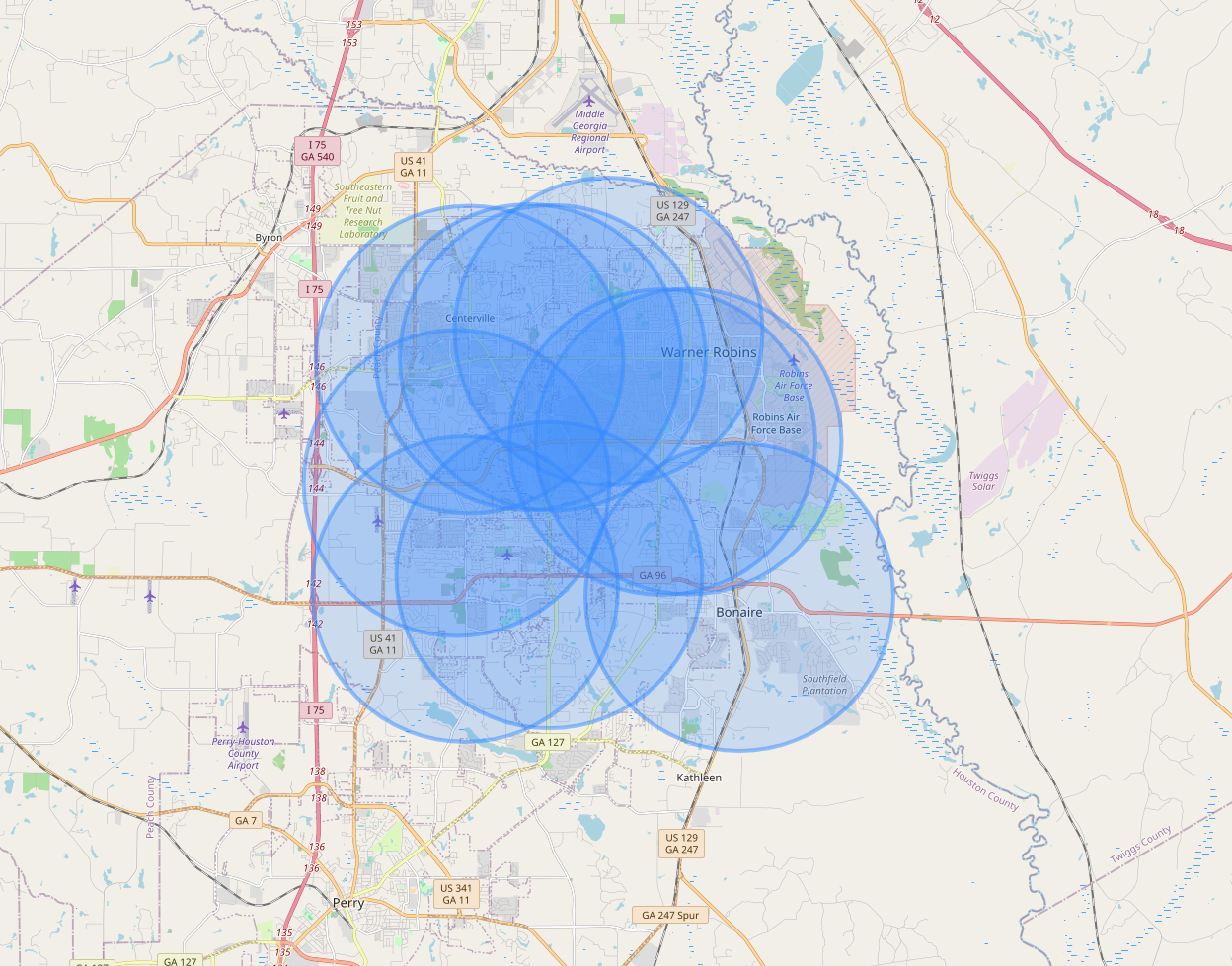
Who doesn’t love a village? So villages it is. But here’s the good news. We don’t need to start from scratch. While it is understood that zoning around our village nodes should allow for greater commercial and residential density, what is often missed is that our adjacent or nearby commercial and residential spaces must assimilate through their transportation infrastructure, and that matters more than the perceived need to manufacture density. We have density.. more than most people realize. And we also have nodes. Within 5km/3.1miles of the following grocery stores and their nearby major intersections we have populations ranging from 16-60 thousand people.
- Kroger (Watson/Margie) Pop 46,763
- Food Depot (Watson/Nelson) Pop 61,786
- WM (Watson/Carl Vinson) Pop 59,286
- WM Neighborhood Market (Green/N Houston) Pop 56,799
- WM (Russell/S Davis) Pop 47,811
- Kroger (Russell/Moody) Pop 54,353
- Kroger (Hwy 96/S Houston Lk Rd) Pop 41,647
- Publix (Hwy 96/Lake Joy) Pop 35,023
- WM Neighborhood Market (Russell/Lake Joy) Pop 43,173
- Publix (Old Hwy 96/Hwy 247) Pop 16,625
Five kilometers is about a 20 minute bike ride, a little too far for most to walk, but within 1 kilometer of our village center we would be encouraging greater density. So let’s repeat: We establish existing grocery stores as anchors of our village centers. We encourage greater density within 1 kilometer of these village centers. We build or repurpose existing infrastructure to create safe for all ages and abilities mircromobility routes from new or existing residential housing within 5 kilometers into and around our village centers.
And from the image below we can see that we’d pretty much have Warner Robins covered. Those grocery store people may be smarter than we think?
This is but one of the many solutions to a connected, vibrant, prosperous, healthy, and happy Robins Region that Ride Robins will propose as we aim to promote micromobilty and the social, economic, and health benefits that it brings.
In a future article we will explore some of these villages in more detail.
 Ride Robins
Leave a comment