

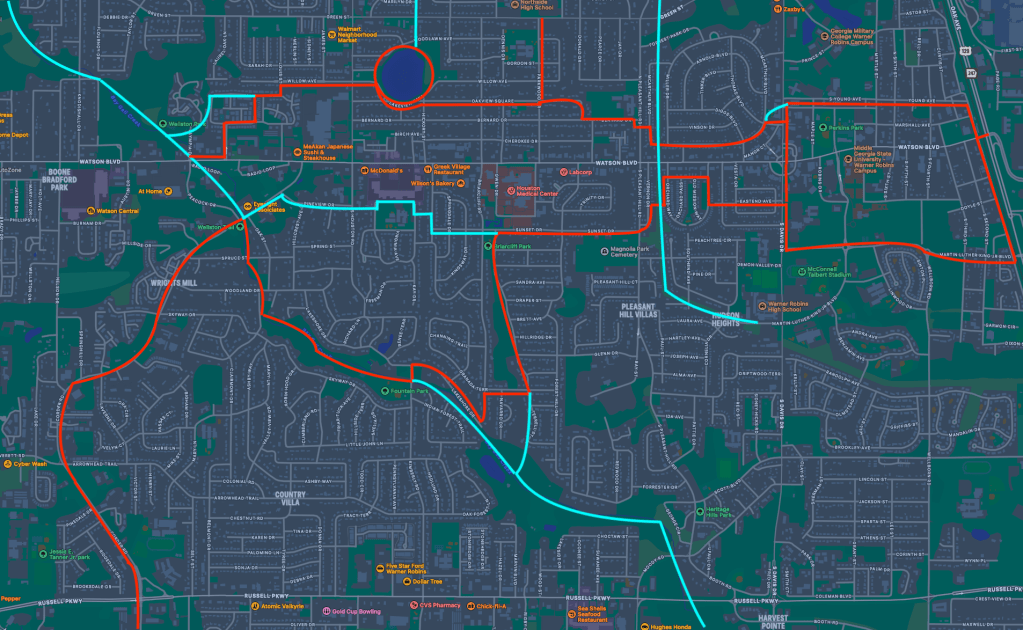
Ride Robins’ goal is to establish safe for all ages and abilities active transportation routes to meaningful locations throughout the Robins Region. At the outset, these will be informal routes built on folk knowledge and crowdsourcing.
Over time, with support from local governments, these routes can be formalized. In a separate article we will explore our first proposed route for the City of Warner Robins, and in future articles explore what can be done in the broader Robins Region.
While the Netherlands is well-known for bicycle infrastructure, what most people do not know is that around 70% of its network is made up of spaces that are shared with automobiles at slow speeds. In the Robins Region, like in many places internationally and domestically, there will be four core types of infrastructure that make up our network: neighborhood greenways, shared use paths, cycle tracks, and greenways. Let’s look at these concepts:
Neighborhood Greenways:
Seattle is just one example of many US cities using the neighborhood greenway concept to accelerate their active transportation networks in a cost-effective way. Warner Robins and the Robins Region are very well-suited to this type of infrastructure.
Shared Use Paths:
These are common throughout the United States with the most prominent example in Georgia being the Atlanta Beltline.
In the Robins Region, we can look toward our robust sidewalk network. Note the phrase, “sidewalks designated as shared-use”. Our sidewalks have long distances between destinations that make them largely unsuitable for errands or commuter walking, but on a bike, especially an ebike, the distances are comfortable. [please note that the use of the term bike here is meant as a catch all for any variety of micromobility devices.]
A significant challenge here is OCGA 40-6-144. Georgia is one of only 3 states where riding a bicycle on a sidewalk is outlawed statewide, not to mention e-scooters and other micromobility devices. While it certainly makes sense that within central business districts, where shop doors open directly to a sidewalk, riding a bicycle would be prohibited, that is not the environment in most of Houston County. Houston County and its jurisdictions have miles and miles of sidewalks, with lengthy distances between intersections and driveway cuts, characterized by long setbacks and sightlines.
In most cases, these sidewalks line roads with high speed traffic. Even in areas where the speeds are 35 mph, traffic often moves significantly faster due to the design speed of our roads. To be on a bike in such environments is not safe for all ages and abilities. Most people, even if interested, will just not do it.


(image from google maps)
In Florida, with a built environment like much of Georgia, bicycles have the same rights and duties as pedestrians and must yield the right of way to pedestrians (Section 316.2065 [9, 10], F.S.). Most bicycle riders in the Robins Region are already riding on sidewalks, unaware or smart enough to not care that they are in violation of Georgia law.
Ride Robins’ position is that much of our sidewalk network can and should be designated as shared use paths. Riders should be careful, but over time driveways and intersections can be made safer and key sections can be widened to modern shared use path standards. If we are going to build a robust active transportation network at reasonable cost, it is critical that we incorporate our existing sidewalks where it makes sense.
Greenways:
Greenways are shared use paths. The distinction is that greenways are largely in natural settings. In Houston County, we have three prominent greenways that can be incorporated into our network: Wellston Trail, The Walk at Sandy Run, and in Perry Big Indian Creek Weleetka Trail.
Warner Robins does have plans to extend Wellston Trail. Ride Robins strongly supports this and hopes to help move the project along in any way possible. In addition, perhaps someday the dirt roads throughout the Oaky Woods WMA could someday be accessible from our active transportation network.
Cycle Tracks:
Cycle tracks are distinct from bike lanes in that they separate cyclists from motor traffic and provide a higher level of security than bike lanes and are attractive to a wider spectrum of the public. No one in their right mind would allow their child to ride on this section of Hwy 96 with a traditional bike lane:

(image from google maps)
Speeds here are 55 mph, but traffic is often moving significantly faster. We can not allow “professionals” to design stuff like this and go home feeling like they’ve accomplished something!
To be fair, we do have roads that struggle with capacity, but we also have roads that are over-built and encourage speeds much faster than the context should promote. Many of these, with only paint and inexpensive materials, can be suitable for cycle tracks. Some of these will be explored in a future article.
In Conclusion:
Safe for all ages and abilities active transportation routes to meaningful locations throughout the Robins Region are far more achievable than most people realize. Ride Robins is here to facilitate that reality.
 Ride Robins
Leave a comment