
Few people understand how our built environment comes to be, and how the place we live is shaped not only by political leaders, land use, planning and zoning, but more subtly our streetscapes, transportation policy, and engineering standards. Once a hardscape is built, it may be 30 years until it’s touched again, and it will shape how we behave in its domain.
Culture is downstream from “environment”; it’s reasonable to argue that. The physical, mental, and economic benefits of well designed streets, roads, and highways, no matter their priorities or location, is well-established. Nobody wants to sit in traffic. Most of the time it’s not traffic, but traffic lights that are our tormentors. Roundabouts would be better for us due to our street layouts. Don’t believe me? Take a look at traffic counts. If you haven’t been through the new roundabout at 247, Pio Nono, and Broadway, which is handling close to 37,000 cars per day, then do so and make note of your experience.
Standards, designs, and technologies evolve. The above-mentioned roundabout could possibly be better with enhanced pedestrian and/or bike infrastructure, but since it’s outside our area, I’ll skip it.
The second half of the 20th century, the time during which most of the Warner Robins Area Transportation Study Metropolitan Planning Organization boundaries became urbanized and big enough to require an MPO by federal mandate, is a time dominated by automobile infrastructure at the expense of walking, biking, or any other form of transportation. The Draft 2050 Metropolitan Transit Plan reflects a permanent inflection point for Warner Robins, Perry, Centerville, Byron, parts of Peach County, and the whole of Houston County in which we dip our toe into the 21st century.
The public review period for the plan is open through September 24th. “The Metropolitan Transportation Plan (MTP) identifies the transportation needs for roads, bridges, public transportation, bicycles, pedestrians, and freight movement in the year 2050 based on the anticipated growth in the MPO area.”
Below are comments sent to the WRATS transportation planner on behalf of myself and Ride Robins. Anyone who supports what’s expressed in these comments please share your thoughts online, as well as email (respectfully and professionally!) our transportation planner with reasonable input. The apparent commitment to complete streets should be noted and commended, but we have much work to do.
==================================================
Thank you for your quick response. I can only imagine the details you are managing.
That said, I would ask that you review this feedback openly, and consider with urgency these suggestions. My perspective is this. For 27 years my family and I employed thousands of people. Most of those years were spent within this MPO. We employed younger individuals, starting their lives, and older individuals, often returning to the workforce. We experienced their challenges. And our own lived experiences and time spent learning the subject have broadened that perspective.
If I were still running restaurants and understood the MTP as I do now, I would be more passionate than I am now, but would never have had the time to study it, as most city and county leadership has likely not had time to do to the degree that I am doing here. I would say that if I went back and looked at the MTP plans over time, I would also see changes over time, so it’s fair to believe this feedback is worth the effort.
The commitment to complete streets is encouraging. One hundred percent of Band 3 (2040-2050) and 70 percent of Band 2 (2028-2039) projects have a “recommendation of bicycle/pedestrian infrastructure in accordance with GDOT’s Complete Streets Policy”. Zero percent of Band 1 (2026-2027) projects adopt complete streets, however.
Like businesses and governments alike have done with the Americans with Disabilities Act, any large project should bring equipment and layouts to the latest standards. I would hope since GDOT is a member of AASHTO their standards would be based on the AASHTO Guide for the Development of Bicycle Facilities Fifth Edition 2024. I would also hope that we stay true to these recommendations. Using our right of way space effectively does not always mean wider and faster. Places that attract human beings to be outside their vehicles, and places that connect meaningful nearby locations have a quality of life and economic impact that is far reaching. And much can be done with quick build tactical approaches.
Not all roads should be complete streets, of course. The most obvious exception are interstates. But a complete street does not a network make, so here are the projects worthy of comment:
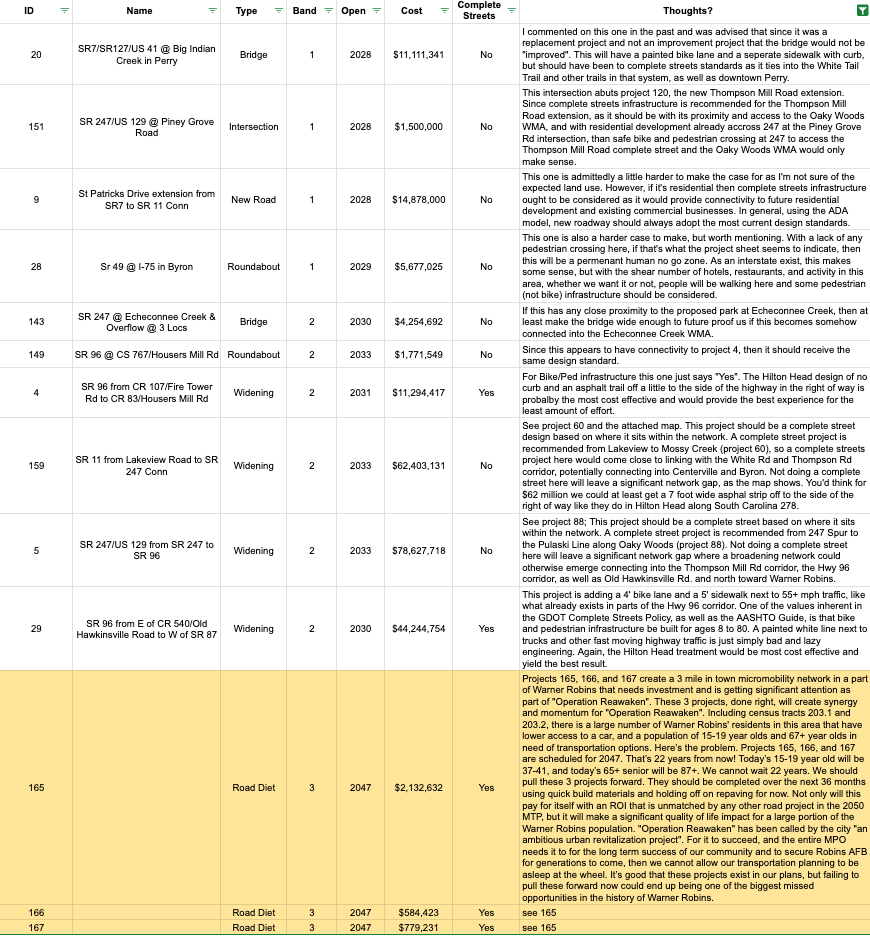
Here are what I consider to be the 10 biggest misses of the 2050 MTP, although I bet you can think of even more:
| 1 | Russell Parkway | There is a severe lack of pedestrian crosswalks on Russell Pkwy west of Belmont Dr, which has a pedestrian signal and crosswalk but is not ADA accessible. From Belmont Dr west it is more than 6 miles until the next pedestrian signalized crossing is reached at Buc-ee’s. |
| 2 | Russell and Corder intersection | I’ve long dreamed that the Corder and Russell intersection become a visual gateway into Warner Robins.. a roundabout with first class bike/ped infrastructure and centerpiece artwork honoring our military history would be really nice, but let’s at least get pedestrian crossing here. |
| 3 | Russell and Lake Joy | Need pedestrian crossing here. |
| 4 | South Corder Road | I’m hearing talk of widening. What it needs is a quick build road diet to include seperated bike/ped infrastructure which would result in speeds actually being closer to the 35 mph posted speed. |
| 5 | Houston Lk Rd and South Corder Rd Intersection | A roundabout here would slow traffic down as well as move it more efficiently; add qulity bike/ped infrastructure and now people from the surrounding and developing neighborhoods nearby could walk to Southside Baptist Church when the weather is nice. |
| 6 | Houston Lk Rd Corridor from Russell to Feigin Mill Rd | Close off left turning actions and add a gauntlet of roundabouts at Feigin Mill Rd, Tucker Place, Mossy Ridge, South Corder Rd, and Russell Pkwy. This would keep traffic flowing smoothly, but at speeds closer to the design of 45 mph. Only right turn allowed; use roundabouts to turn other way. |
| 7 | Houston Lk Rd and Perry Parkway | With mixed use and further development in this area, a safer crossing experience should be explored. |
| 8 | Intersections (in general) | If the public at large fully understood the traffic capacity improvements, the safety record, and the potenital beautification of roundabouts hardly a good person would oppose. Any “intersection improvement” should first and foremost be explored as a potential roundabout. See Carmel, IN or Oxford, MS. |
| 9 | Neighborhood Streets and Traffic Calmning | Crickets |
| 10 | Watson, Armed Forces Blvd, and 247 | As an emerging restuarant zone grows along Armed Forces Blvd, and the sun rises on “Operation Reawaken”, this intersection could become even worse than it is. |
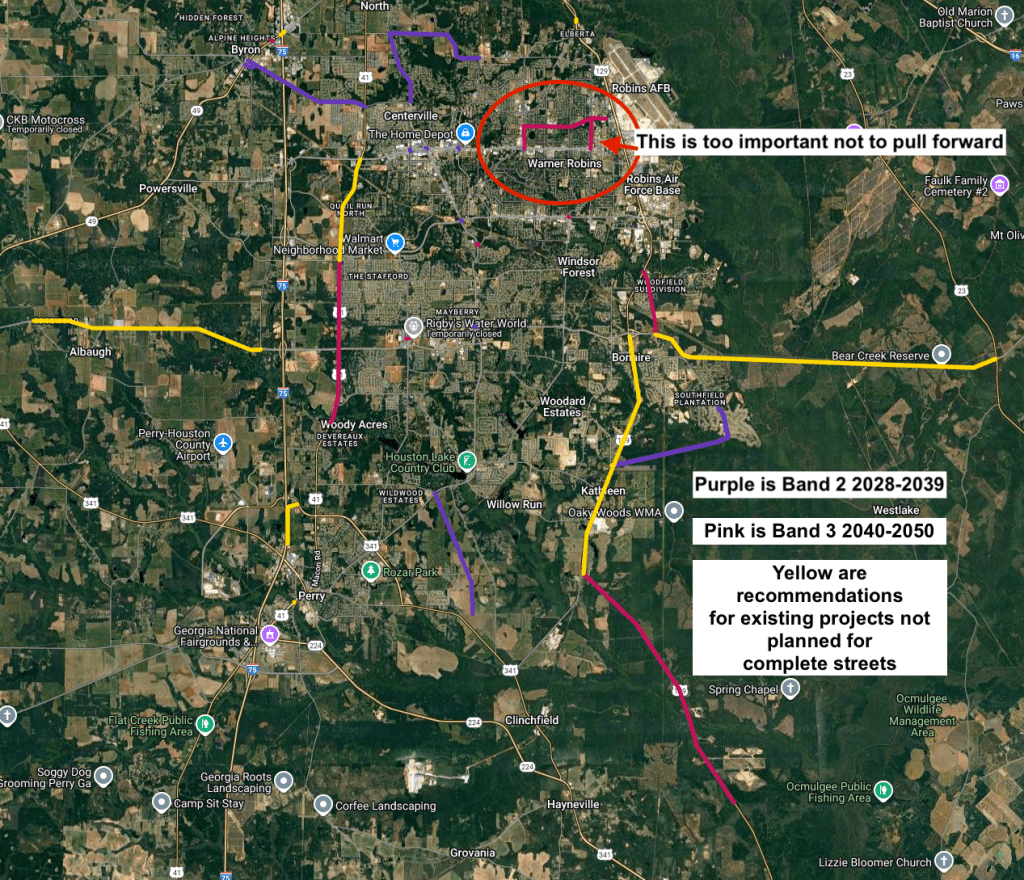
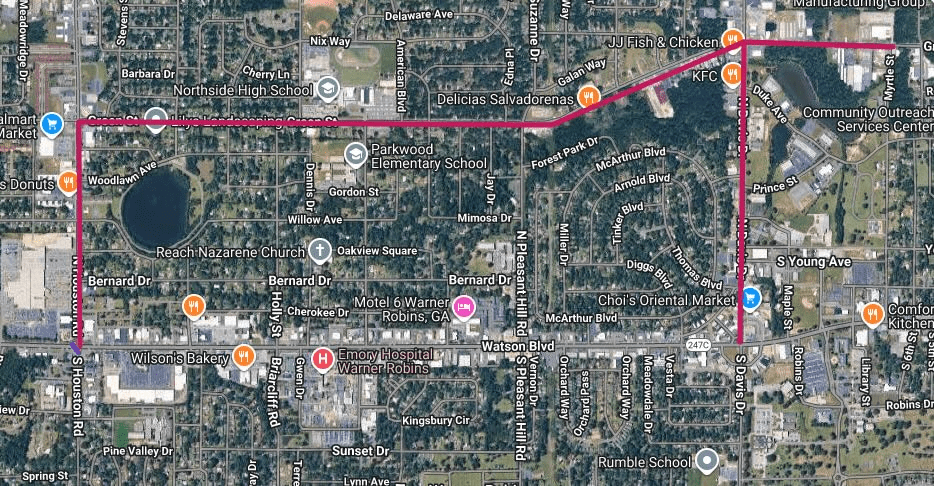
Attached are two maps. The first shows what our complete streets network would look like in 2050 if all planned, as well as my recommendations, were followed through on. The second is a close up of the Green St corridor. If you take nothing away from this feedback, please at the very least consider the lasting positive impact that pulling the Green St corridor forward would have on the physical, mental, and economic health of a large number of residents in the MPO.
 Ride Robins
Leave a comment