

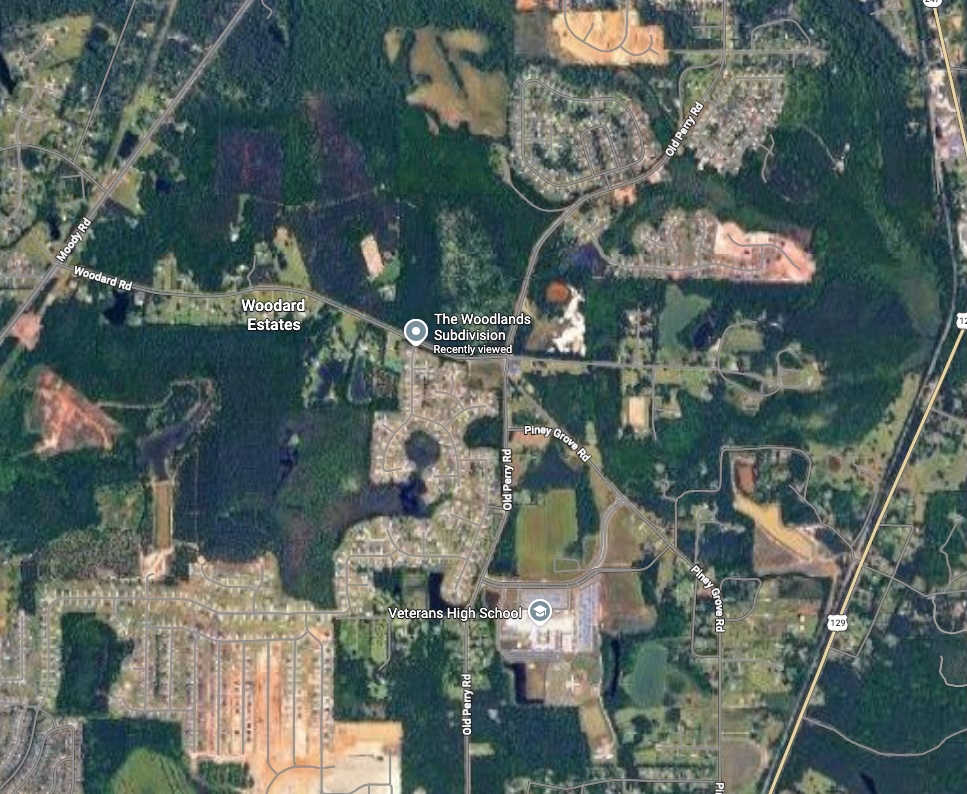
Residents of The Woodlands have raised concerns about a proposed gas station near their neighborhood. Their concerns are understandable. Most people do not want additional traffic, noise, lights, or potential pollution near their homes.
But what if the gas station is not the problem? What if it is simply a symptom of a larger pattern?
Over the last several decades, Houston County has largely grown through a combination of residential subdivisions, separated land uses, and road networks designed almost exclusively around driving. Thousands of homes have been built in places where nearly every trip requires a car. The layout of streets encourages car trips at the expense of almost everything else.
At the same time, neighborhood-scale businesses that once existed within or near residential areas have largely disappeared from our zoning codes. Historically, homes, shops, schools, churches, and civic spaces often existed within walking distance of one another. When a community is built differently, certain outcomes become predictable.
Automobile traffic is concentrated onto a relatively small number of arterial roads. Commercial activity follows those traffic volumes. Major intersections become attractive locations for gas stations, convenience stores, drive-through restaurants, car washes, and other roadside businesses.
The result is a cycle that feels familiar across the region. A subdivision is approved. Traffic increases. Commercial demand follows. Residents object to the commercial uses. Roads are widened. More traffic arrives. The process repeats until growth moves farther outward, while existing residents are left with the long-term costs of maintaining additional roads, utilities, and public infrastructure.
The gas station did not create this pattern. The pattern created the demand for the gas station. Some people will argue there is no demand for a gas station near The Woodlands, or that they will choose not to patronize it. Perhaps they are right. But if the project moves forward, it will likely do so because the broader development pattern has made that location commercially attractive.
This is not a criticism of The Woodlands. Like many neighborhoods across Houston County, including my own, it reflects a development model that has become standard practice throughout much of the United States since World War II. Nearly all of Houston County has been developed during this period.
The more important question is what comes next?
Should we continue expanding outward through disconnected subdivisions that depend on a handful of major roads? Or should we begin making it easier to build housing, businesses, and destinations within our existing communities? Should we update our subdivision standards to require meaningful pedestrian and trail connections between neighborhoods while still discouraging cut-through traffic? Would these changes create opportunities for different kinds of neighborhood-serving businesses?
Many of the places people love most—historic Perry, downtowns and traditional neighborhoods throughout Georgia, Savannah, Charleston, and countless small towns across America—were built differently. They allowed homes, businesses, parks, schools, and civic spaces to exist closer together. They provided multiple routes through town instead of concentrating everything onto a few corridors. And many communities are now rediscovering these principles, not because they are nostalgic, but because they work.
Across the country, cities and towns are revisiting zoning codes, allowing a wider range of housing types, improving connectivity, and making it easier to build neighborhoods where people can live, work, shop, and gather closer to home. Places such as Carmel, Indiana—frequently ranked among the most desirable places to live in America—have embraced many of these ideas while continuing to grow and prosper.
The debate over one gas station may seem small. But it raises a much larger question: If we continue building communities where every trip requires a car, what alternative outcome should we expect?
Perhaps it is time to spend less energy debating individual projects and more time discussing the development pattern that produces them. If we want different outcomes, Houston County, Perry, and Warner Robins will need to consider meaningful zoning and connectivity reforms.


Leave a comment